
Topic Areas WS26/27
Description:
There are many creative platforms and propulsion concepts in mobile robotics, and we want to add one more. A stiff, spherical structure should be propelled by outward spiking pins, which is a challenge on many levels, including estimation and control. Your task is to work on building simulations for the platform and analyze the situation with a focus on required forces, controllability, dimensions and hardware feasibility. Depending on the progress, working on a hardware prototype can begin.
Tasks:
- Design simplified and prototype versions of the robot using CAD software
- Simulate dynamic behavior with, e.g., MuJoCo and custom models
- Plan the system architecture, dimension parts and prove feasibility
Requirements:
- High interest in mechatronic systems and the simulation of them
- Knowledge in computer aided design (mechanical or electrical)
- Basic skills in control theory are an advantage
Description:
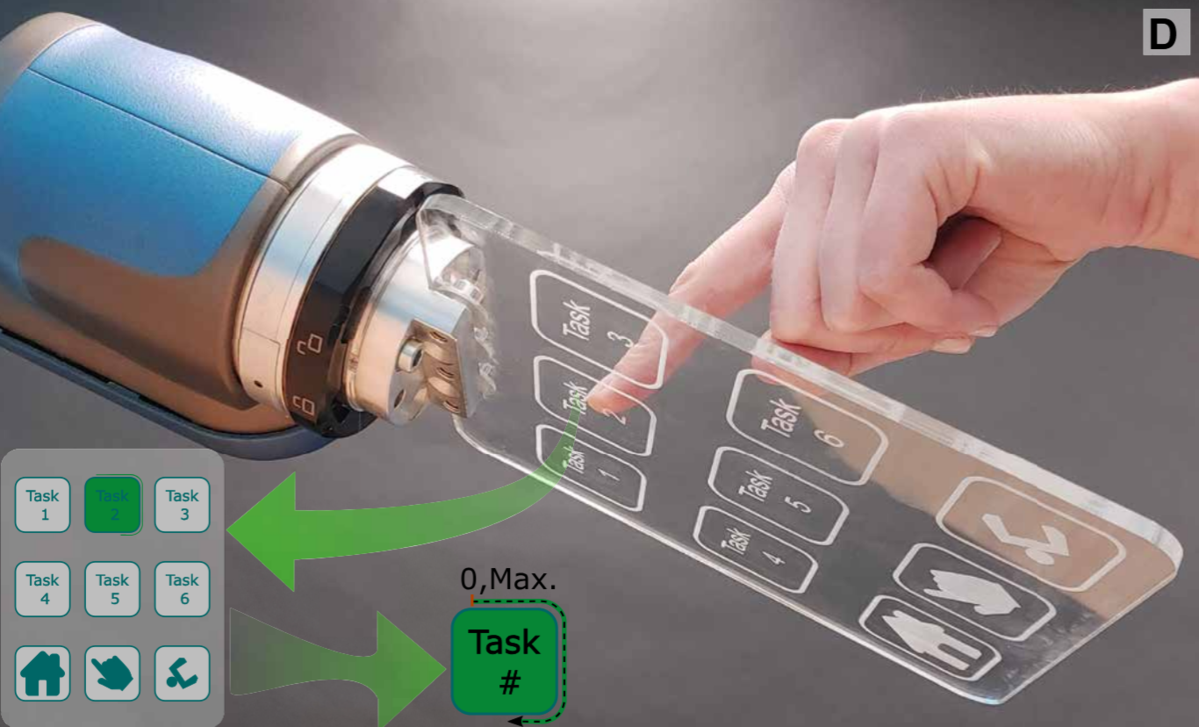
In haptic human-robot interaction, intrinsic contact sensing offers the ability to determine points of contact directly using force-torque sensors. In combination with VR headsets for extended reality, this approach could enable the creation of variable input fields. The goal of this project is to use a plate attached to an F/T sensor as an interactive “force touchpad” on which users can tap, draw, or write with their fingers, and to visualize the “input” using XR. A haptic interface equipped with an F/T sensor and VR devices are available for this purpose.
Tasks:
- Familiarization with hardware components and methodology
- Implementation of the physical model for calculating contact coordinates from sensor data
- Development of interaction modes (buttons, character recognition, etc.)
- Development and implementation of the visual interface
Requirements:
- Knowledge of ROS, Python, C++, and C# (preferred)
- Basic knowledge of Unity (not required)
- Ability to learn and work independently as well as collaborate in a team
Literature :
- [1] Iskandar, M., Albu-Schäffer, A., & Dietrich, A. (2024). Intrinsic sense of touch for intuitive physical human-robot interaction. Science Robotics, 9(93), eadn4008.
- [2] Kim, U., Jo, G., Jeong, H., Park, C. H., Koh, J. S., Park, D. I., ... & Park, C. (2021). A novel intrinsic force sensing method for robot manipulators during human–robot interaction. IEEE Transactions on Robotics, 37(6), 2218-2225.
- [3] Sinico, T., Boschetti, G., & Neto, P. (2025, October). Enhancing physical human-robot interaction: Recognizing digits via intrinsic robot tactile sensing. In IECON 2025–51st Annual Conference of the IEEE Industrial Electronics Society (pp. 1-7). IEEE.
- [4] Fennel, M., Walker, M., Pikos, D., & Hanebeck, U. D. (2025). HapticGiant: A Novel Very Large Kinesthetic Haptic Interface with Hierarchical Force Control. IEEE Transactions on Haptics.
Project 3 - Variational Optimization with Deterministic Sampling for Model Predictive Control
- Contact:
Description:
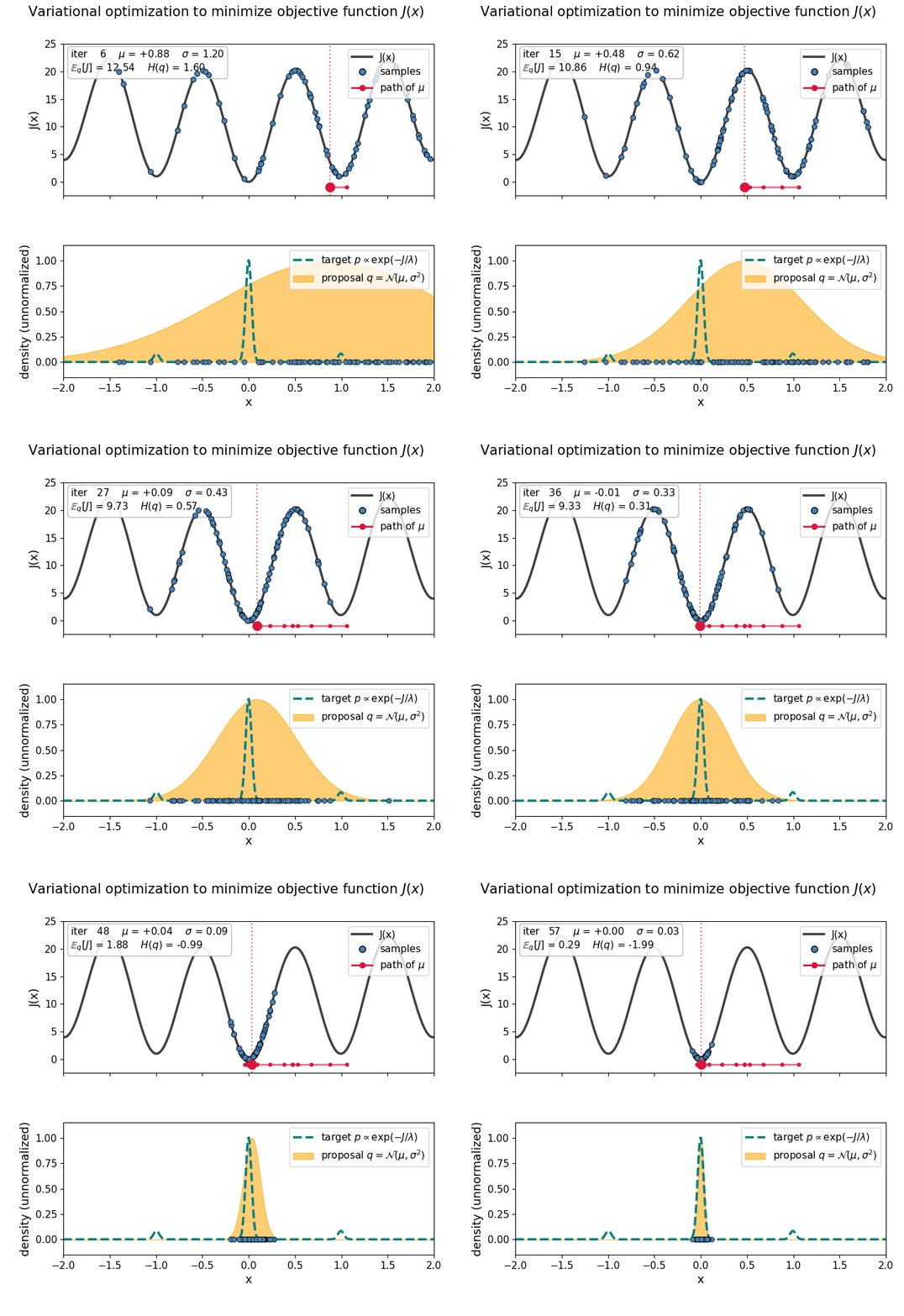
Variational optimization offers a different perspective on numerical optimization by optimizing a probability distribution over candidate solutions rather than directly searching for a single solution. This combines gradient-based optimization with sampling-based exploration: gradients efficiently improve the distribution, while samples allow the optimizer to explore different regions of a potentially non-convex solution space and reduce the risk of getting trapped in local minima. These properties are particularly interesting for model predictive control (MPC), where a sequence of future control actions must be optimized repeatedly for nonlinear dynamical systems. The approach is also closely related to concepts from modern reinforcement learning, where distributions over actions or policies are optimized to achieve desirable long-term behavior. An important question is how the choice of samples influences the efficiency and quality of this optimization process. Low-discrepancy and localized cumulative distribution (LCD) samples offer deterministic alternatives to conventional random sampling and may provide more efficient coverage of the relevant solution space.
Tasks:
- Implement and validate two variational optimization methods in JAX using an existing code example as a starting point.
- Extend the methods with Monte Carlo, low-discrepancy (Sobol/Halton), and LCD-based deterministic sampling (existing code available).
- Evaluate the methods and sampling strategies on standard nonlinear optimization benchmarks, investigating convergence, objective value, computational effort, and sample efficiency.
- Apply the variational optimization methods to nonlinear model predictive control using selected control environments.
- Compare the resulting controllers with conventional MPC methods.
Requirements:
- Good programming skills in Python are required; experience with JAX is beneficial.
- Basic knowledge of control or reinforcement learning is required.
- Basic knowledge of numerical optimization is desirable.
Literature :
- [1] Blessing et al., Trust Region Constrained Measure Transport in Path Space for Stochastic Optimal Control and Inference, arXiv:2508.12511, 2025.
- [2] Hanebeck et al., Dirac mixture approximation of multivariate Gaussian densities, Proceedings of the 2009 IEEE Conference on Decision and Control (CDC 2009), 2009.
Description:
This project explores Bayesian state estimation with modern diffusion models. Instead of representing the state posterior only by Gaussian distributions or random particles, the method uses a score-based diffusion model to represent complex, potentially non-Gaussian beliefs. Measurements are incorporated gradually through a progressive Bayesian update. The project investigates whether deterministic Gaussian sampling can improve this update by providing stable, low-variance approximations of likelihood-related quantities. The goal is to develop and evaluate a prototype filter for nonlinear benchmark systems, comparing accuracy, robustness, and computational cost against particle and Gaussian filters.
Tasks:
- Implement progressive likelihood updates and deterministic Gaussian sampling.
- Implement a basic score/diffusion-based probability density function representation.
- Implement the continuous-time prediction step and discrete-time measurement update.
- Compare against state-of-the-art filtering methods.
Requirements:
- Basic programming in Python and Matlab
- Basic knowledge of probability and Bayesian estimation
- Interest in machine learning or generative models
Literature :
- [1] Song et al., “Score-Based Generative Modeling through Stochastic Differential Equations,” 9th International Conference on Learning Representations, 2021.
- [2] Bao et al., “A Score-Based Filter for Nonlinear Data Assimilation,” Journal of Computational Physics, 2024.
Description:
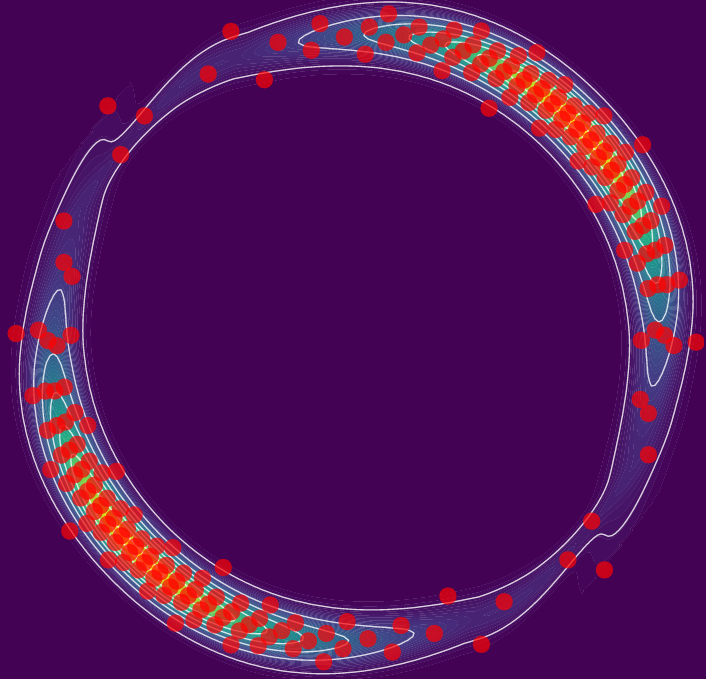
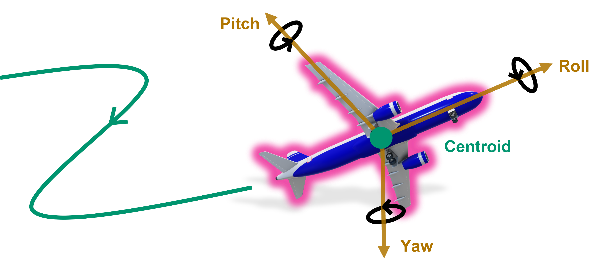
This project investigates state estimation for systems whose state combines 3D orientation with continuous variables such as position, velocity, angular velocity, or shape. The goal is to represent and recursively propagate the full probability density directly on the mixed state space of SO(3) and high-dimensional Euclidean space. A particular focus is placed on the representation and discretization of three-dimensional rotations. Students will investigate suitable parameterizations of SO(3) and their geometric properties, and how rotational uncertainty can be discretized efficiently and consistently for grid-based Bayesian filtering. Based on this representation, a recursive, geometry-aware grid filter for the joint rotational and Euclidean state will be developed.
Tasks:
- Study and compare suitable parameterizations and discretizations of SO(3).
- Setup simulated joint rotational–Euclidean state-estimation scenarios.
- Implement a geometry-aware grid representation on the mixed state space of SO(3) and high-dimensional Euclidean space.
- Develop and evaluate a recursive grid-based Bayesian filter.
- Analyze estimation accuracy and computational scaling.
Requirements:
- Basic programming skills in Python and Matlab
- Basic knowledge of probability, linear algebra, and numerical methods
- Interest in robotics, 3D geometry, or state estimation
Literature :
- [1] Jiachen Zhou, Marvin Schanz, Noah Jens, Harald Kruggel-Emden, Uwe D. Hanebeck, Parametric and Tensor-Based Nonparametric Filtering for Extended Object Tracking with Mixed Euclidean–Directional States, Proceedings of the 2026 IEEE International Conference on Multisensor Fusion and Integration (MFI 2026), Pilsen, Czechia, September, 2026.
- [2] Daniel Frisch, Uwe D. Hanebeck, Fokker-Planck Prediction on the Cylindric Manifold using Tensor Decomposition of a Regular Grid, 17th Symposium Sensor Data Fusion: Trends, Solutions, Applications (SDF 2025), Bonn, Germany, November, 2025.
- [3] Demissie, Bruno, Muhammad Altamash Khan, and Felix Govaers, Nonlinear filter design using Fokker-Planck propagator in Kronecker tensor format, 2016 19th International Conference on Information Fusion (FUSION). IEEE, 2016.
Project 6 - Cooperative Multi-Agent Reinforcement Learning for a Multi-Actuator Array Sorter
- Contact:
Description:
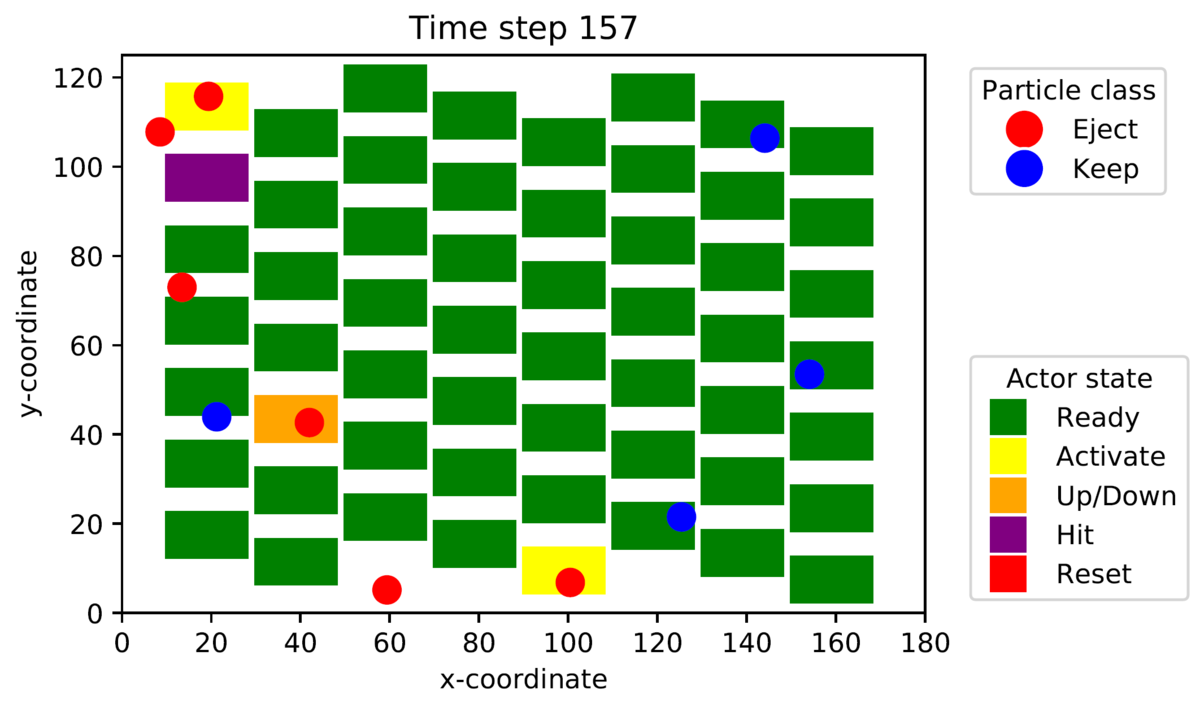
In cooperative multi-agent reinforcement learning (MARL), multiple autonomous agents jointly learn a strategy to solve a task through interaction with their environment. As part of this practical course, an existing MARL model for controlling a multi-actuator array sorter (video) will be enhanced. Each mechanical actuator is treated as an independent agent whose decisions must be coordinated with those of neighboring agents. The objective is to achieve high sorting quality with minimal actuator effort. To this end, scalable policy architectures featuring parameter sharing and inter-agent communication, such as through graph neural networks (GNNs) or attention mechanisms, will be investigated. The developed models will then be transferred to an existing prototype, where they will be evaluated and iteratively improved regarding the sim-to-real transfer.
Tasks:
- Familiarization with MARL and the existing software
- Optimization of the simulation environment, e.g., using JAX and GPU acceleration
- Investigation of the reward function, scalable policy architectures with parameter sharing, and agent communication
- Adaptation of the MARL algorithm (optional) and training of the models
- Investigation of domain randomization and sim-to-real transfer
- Transfer and iterative improvement of the models on the real sorting system
Requirements:
- Basic knowledge of Python
- Basic knowledge of reinforcement learning
Description:
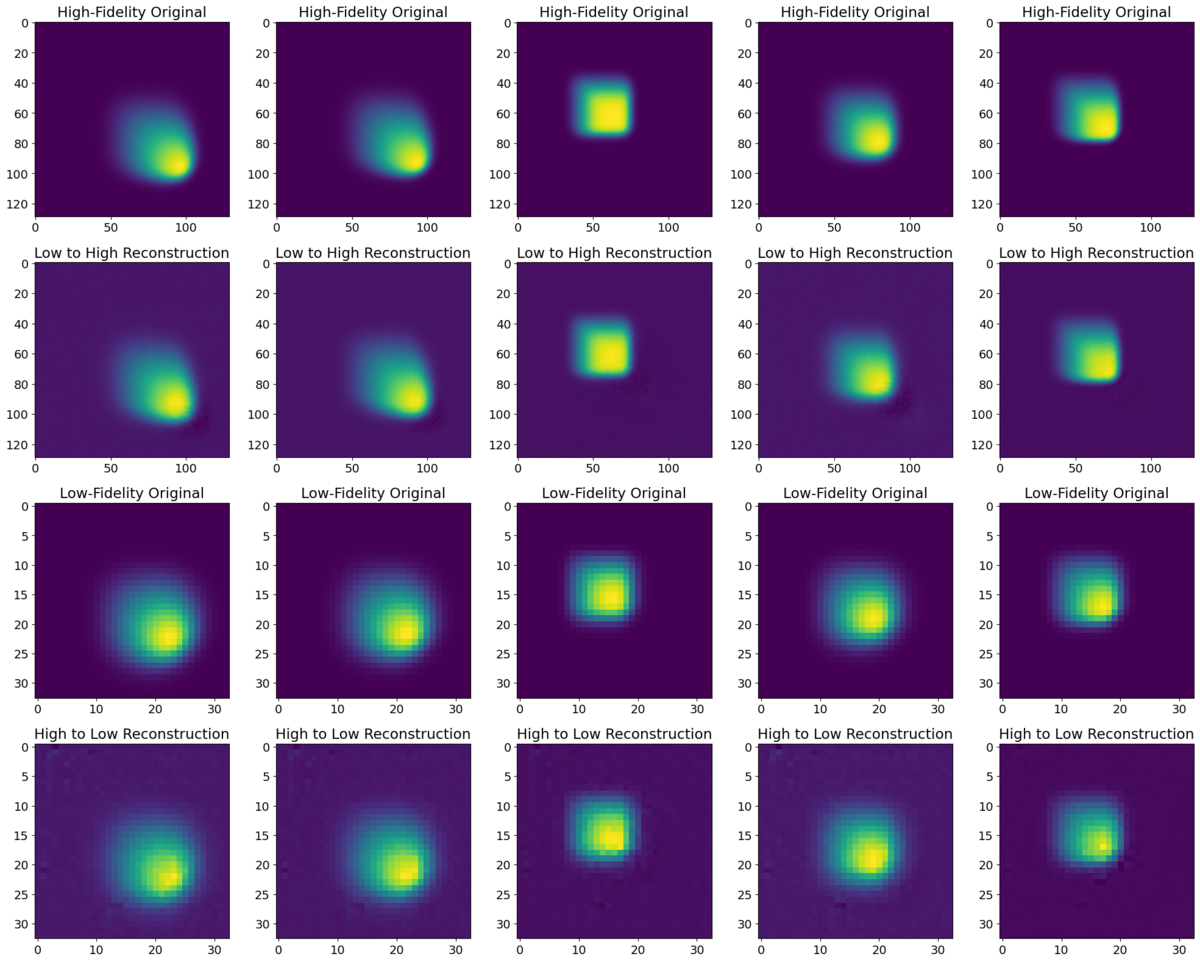
In scientific computing, many simulations are accurate but computationally expensive, which makes it difficult to evaluate them thousands of times or to generate large training data sets. At the same time, model parameters are often uncertain, so the simulation has to be evaluated for many possible parameter values in order to understand the resulting variability. This project investigates how a small number of accurate high-fidelity simulations can be combined with many cheaper low-fidelity simulations to build efficient surrogate models for this purpose. The main benchmark is the two-dimensional heat equation. Students use supplied multi-fidelity tools to select informative high-fidelity simulations and construct reduced approximations of the full system. A compact neural network is then trained to predict this reduced representation directly from the uncertain model inputs. The resulting surrogate is compared with the underlying bi-fidelity method in terms of accuracy, computational cost, data efficiency, and robustness. Finally, the models are used for uncertainty quantification, for example to estimate mean behavior and variability of the simulated system.
Tasks:
- Set up and validate low- and high-fidelity simulations of the two-dimensional heat equation and generate trajectory data for uncertain model parameters.
- Use many low-fidelity simulations to analyze the structure of the solution space, select a small number of informative high-fidelity simulations with the supplied methods, and build a plain bi-fidelity surrogate.
- Train a compact neural network to predict the reduced bi-fidelity representation directly from the uncertain model parameters.
- Make and justify key choices in the experimental setup, including parameter ranges, data generation, neural-network architecture, training settings, and evaluation strategy.
- Compare plain bi-fidelity and the learned surrogate in terms of trajectory accuracy, computational cost, high-fidelity sample efficiency, inference time, and robustness. Use both approaches for Monte Carlo uncertainty quantification of mean behavior and variability.
- If time permits, investigate extensions such as alternative regression or sample-selection methods, local reduced bases, nonlinear reduced representations, or a Burgers-equation benchmark.
Requirements:
- Good programming skills in Python.
- Basic understanding of neural networks and practical experience with training simple neural-network models in Python are expected; prior knowledge of numerical methods and probability is helpful but not required.
- Interest in scientific computing and working experimentally with simulation data.
Literature :
- [1] Zhou, H., Cheng, S., Arcucci, R. (2024). Multi-fidelity physics constrained neural networks for dynamical systems. Computer Methods in Applied Mechanics and Engineering, 420, 116758.
- [2] Hampton, J., Fairbanks, H. R., Narayan, A., Doostan, A. (2018). Practical error bounds for a non-intrusive bi-fidelity approach to parametric/stochastic model reduction. Journal of Computational Physics, 368, 315-332.
Description:
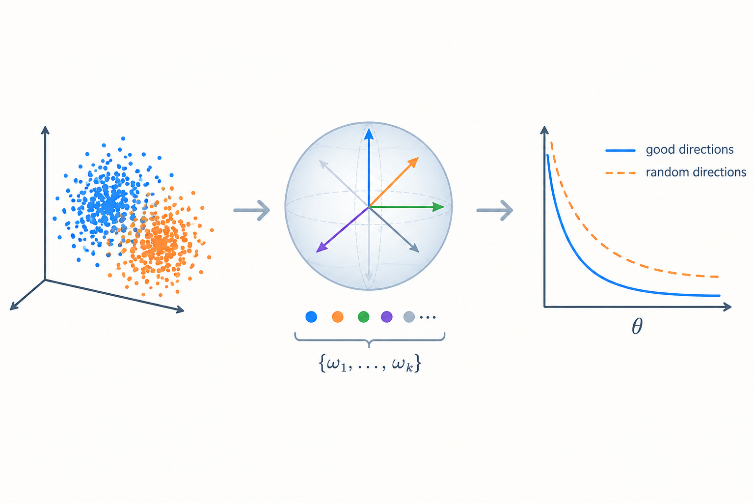
Projected distance metrics compare probability distributions by averaging one-dimensional distances over projections onto directions on the unit sphere. In applications where such distances are used as objective functions, such as sample reduction, distribution matching or generative modeling, only a finite number of projection directions can be used in practice. The choice of these directions can therefore have a significant impact on the efficiency and behavior of the optimization. This project investigates whether carefully selected projection directions can improve optimization with sliced distances compared with standard random sampling, e.g. by requiring fewer projections or leading to faster convergence. Different strategies, including random, orthogonal, quasi-Monte Carlo, structured, and adaptive directions, will be considered and compared.
Tasks:
- Literature research on projected distances and methods for selecting projection directions
- Implementation of different projection-direction strategies
- Comparison of accuracy and computational cost
Requirements:
- Good programming skills in Julia or Python
- Familiarity with probability theory
- Background in optimization and numerical methods
Literature :
- [1] M. Acharya and D. Hyde: Efficient Sliced Wasserstein Distance Computation via Adaptive Bayesian Optimization, ICLR 2026
Project 9 - Improving State Estimation by Learning State-Dependent Uncertainty with Neural Networks
- Contact:
Description:
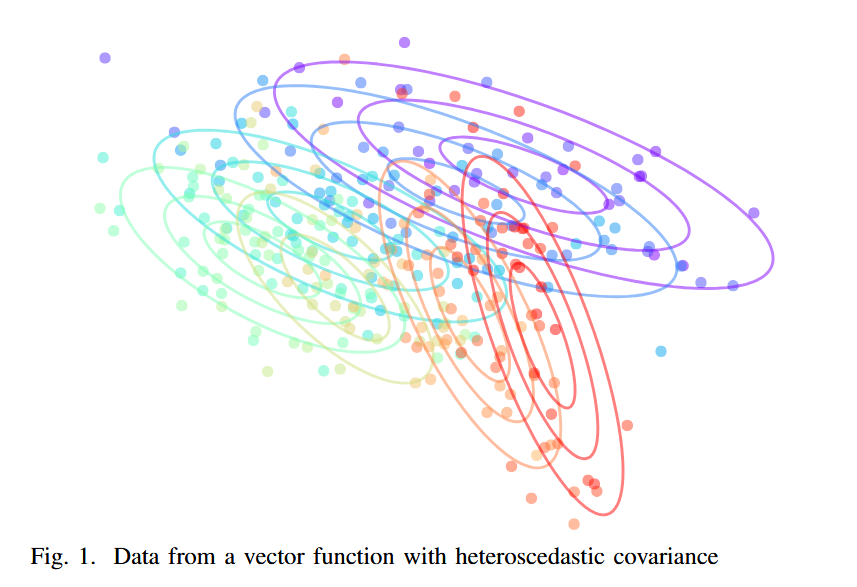
Real-world dynamical systems rarely have constant uncertainty. Sensor and process noise can depend strongly on the current operating state, with some regions being highly reliable while others produce substantially more uncertain measurements or predictions. This project investigates whether neural networks can learn both the expected system behavior and its state-dependent uncertainty from data, with the ultimate goal of improving state estimation. A particular focus is on state-spaces with rare high-variance regions, where conventional likelihood-based training may favor increasing the predicted variance rather than improving the mean prediction. This results in subpar mean fits. The project will investigate whether modified uncertainty-aware training can produce better-calibrated mean and variance estimates and, consequently, improve Kalman-filter-based state estimation. The initial work will use simulated nonlinear dynamical systems, providing controlled ground truth and multiple trajectories with different initial conditions.
Tasks:
- Develop a nonlinear dynamical simulation and generate trajectories with varied initial conditions.
- Train heteroscedastic neural networks to predict mean and state-dependent variance.
- Investigate performance particularly in rare high-noise regions.
- Integrate the learned uncertainty model with an EKF/UKF and evaluate state-estimation performance.
- Explore extensions to learning state-dependent process and/or observation noise.
Requirements:
- Basic knowledge of programming in Julia/Python (with Flux/PyTorch)
- Limited experience with training Neural Networks.
- Interest in topics like state estimation and uncertainty quantification.
Literature :
- [1] Russel et al.: Multivariate Uncertainty in Deep Learning
- [2] Kloss et al.: How to train your differentiable filter
Description:
In security-related fields, it is important to have truly random numbers. These cannot be easily generated using standard deterministic computer architectures; instead, dedicated hardware is required to access some physical process, such as the quantum-based shot noise of a Zener diode. In a previous lab, a simply designed and universally applicable hardware system was developed. This system is to be further improved. Furthermore, the generated random data is to be tested using various benchmarks.
Tasks:
- Small improvements / simplifications in the electronic design
- Evaluate possibilities for small series production for lecture participants
- Add support by Feather with display, visualize dice etc
- Record big dataset and perform extensive benchmarks
- Determine internal bandwidth of random source
Requirements:
- Interest in electronic circuits
- Interest in microcontrollers

Description:
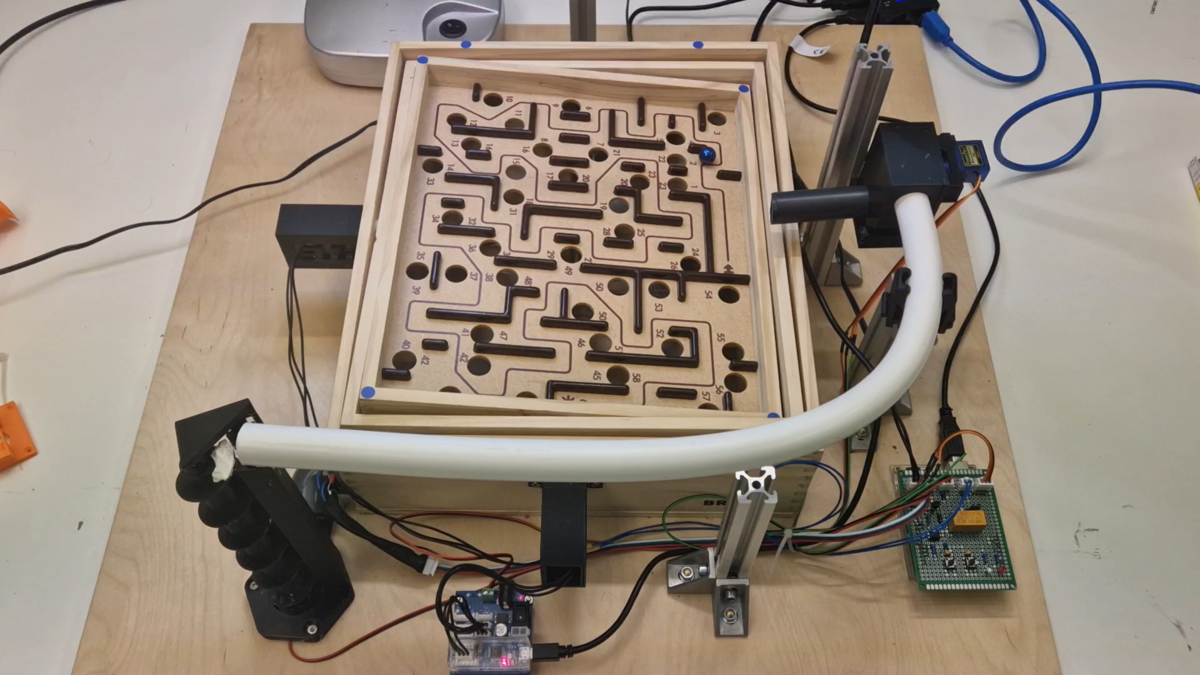
In previous iterations of this project, a Brio skill game was motorized to be operated by a computer. Now, the platform is to be used as a demonstration platform for novel algorithms for Bayesian state estimation and control. To this end, various methods for representing the ball’s motion state and its uncertainty will be implemented, tested, and compared. In particular, novel methods of deterministic sampling will be employed. Building on this, various stochastic control algorithms, e.g., for balancing on a point or moving along a line, will be implemented, again with a focus on new developments in sample-based model-predictive control.
Tasks:
- Reliable state estimation, e.g., with Smart Sampling Kalman Filter
- Add stochastic controller for balancing
- Learn optimal controller behaviour
- Follow a simple line, optionally even the original labyrinth line
- Improve robustness for use as demonstrator platform
Requirements:
- Programming experience
- Interest in control
- Ideally: Experience with ROS
Description:
It is well known that Fibonacci grids describe the arrangement of seeds in many plants. This ensures efficient use of space throughout the entire growth process. Mathematically, this stems from the fact that so-called low-discrepancy points, when transformed orthogonally, generate uniformly spaced points. Unfortunately, grids of comparable quality exist only for certain higher dimensions. This work aims to finding constructions for the missing dimensions. For both existing methods and any newly discovered ones, the grids will be calculated and made available online for broader use.
Tasks:
- Find constructions for the missing dimensions (2D+1 not prime): brute force optimization of the rotation matrix, or generalize mathematical method that already exists for 4D
- Compute the Generalized Frolov-Fibonacci Grid (e.g. 100000 points for 2D to 35D)
- Publish the data for the international community
Requirements:
- Interest in diving into mathematical theory targeting a practical goal
- Programming experience
Literature :
- [1] Daniel Frisch, Deterministic Gaussian Sampling With Generalized Fibonacci Grids